Transform into a smart factory via M2M
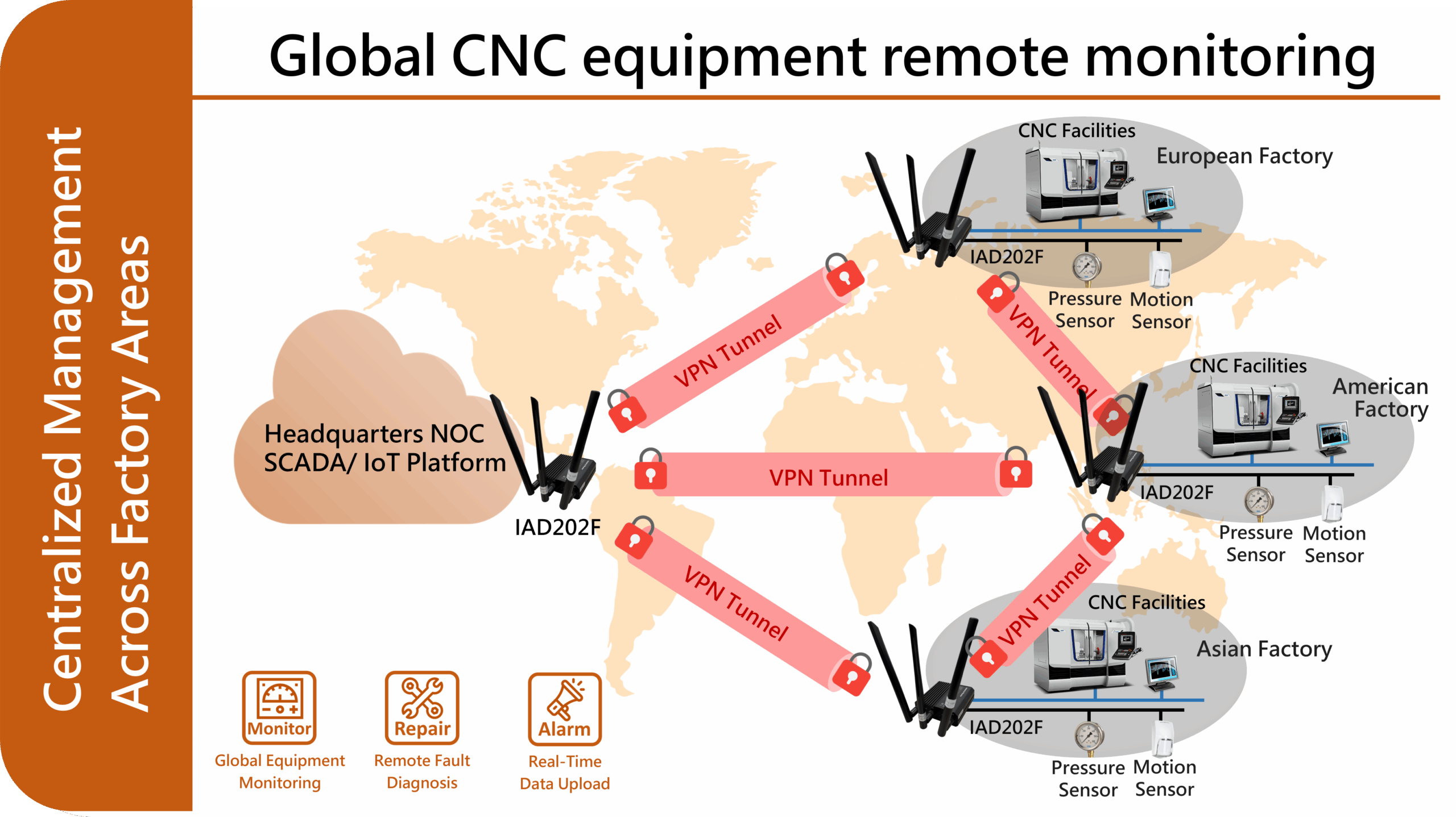
With the rapid development of Industry 4.0 and smart manufacturing, factories are increasingly demanding more networked equipment, real-time monitoring, and data analysis capabilities. While traditional wired networks offer stability, their limitations in flexible deployment, cross-regional connectivity, and maintenance costs are becoming apparent. The introduction of the IAD202F industrial-grade 4G LTE router has become a crucial element in realizing M2M communication in smart factories. Its high stability, robust design, and comprehensive communication capabilities make it a core networking node in smart manufacturing environments.
The core of a smart factory lies in the interconnectivity between devices
Through an M2M architecture, CNC machines, PLC controllers, sensors, and robotic arms on the production line can exchange data in real time and integrate with central management platforms such as MES, SCADA, and ERP. The architecture typically consists of a Device Layer, a Connectivity Layer, and a Platform Layer. The IAD202F is a key device located in the Connectivity Layer, acting as a bridge between the devices and the cloud platform.
The Role of IAD202F in Smart Factories
The IAD202F features an industrial-grade design, enabling stable operation in harsh environments (such as high temperatures, dust). It provides the following core functions, effectively addressing pain points in factory connectivity stability and security.
● 4G LTE Wide Area Connectivity:Supports multi-band SIM cards, suitable for cross-plant or remote locations.
● Multi-WAN Backup Mechanism:Can be paired with wired WAN for dual-link backup.
● VPN Secure Communication:Supports IPsec, OpenVPN, or WireGuard to ensure secure data transmission.
● Industrial Protocol Support:Can be integrated with protocols such as Modbus TCP and MQTT.
● Remote Management and Monitoring:Supports centralized management via TR-069, SNMP, or cloud platforms.
Applications in Electronics Manufacturing
SMT Assembly Line Rapid Reconfiguration
Modern manufacturing trends favor small-batch, high-variety production lines and rapid changeover. Traditional wired networks require rewiring during line reconfiguration, which is time-consuming and costly. The IAD202F 4G wireless capabilities enable rapid equipment deployment. For example, Automated Guided Vehicles (AGVs) can transmit their location and status in real time via 4G; mobile workstations do not require fixed network locations; and temporary production lines can be quickly set up and dismantled. This "wireless production line" significantly improves production flexibility and is particularly suitable for electronics manufacturing, automotive components, and customized production environments.
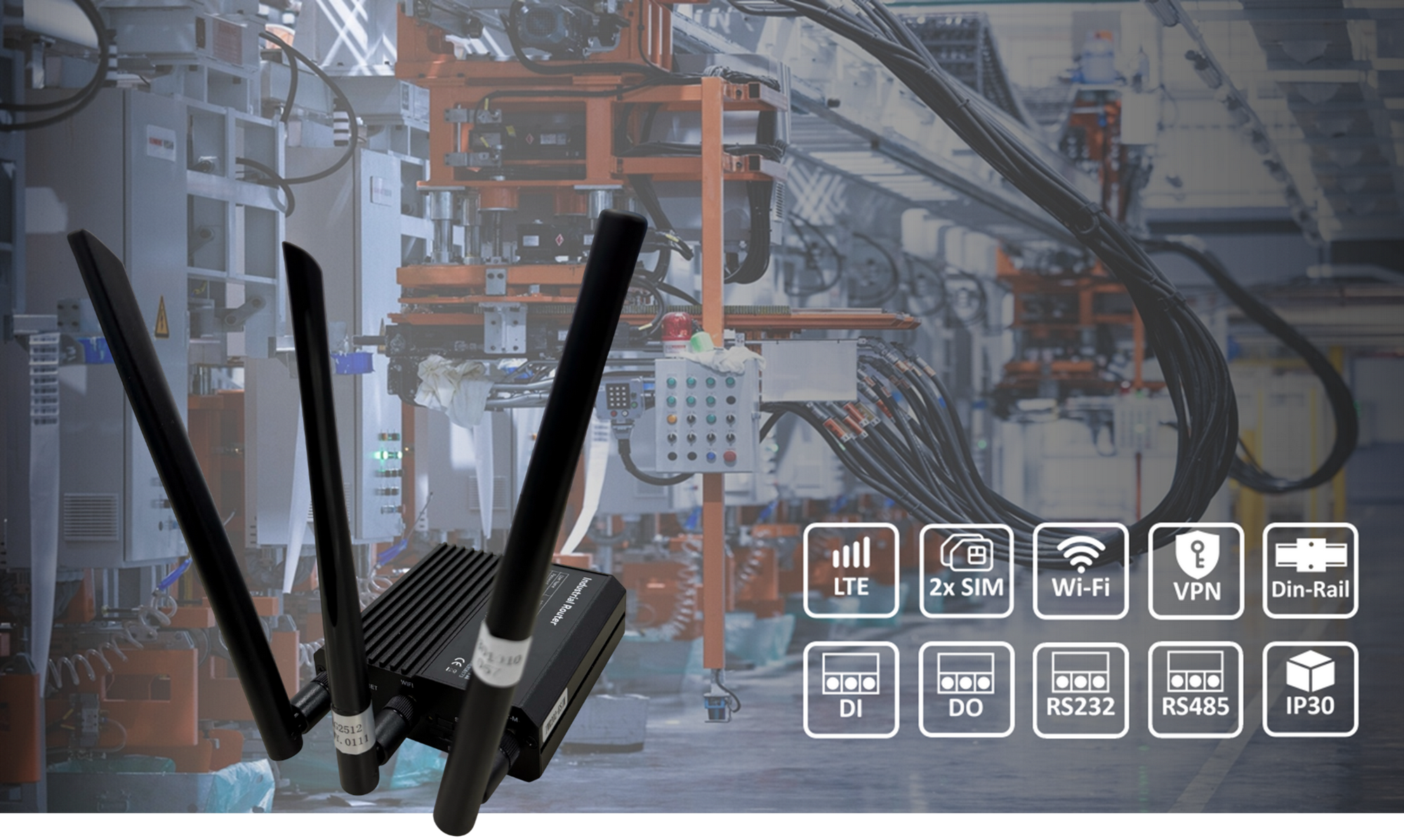
SMT electronics manufacturing plants handle multi-brand orders with short product lifecycles, requiring line configuration changes every few weeks. Traditional wired Ethernet networks face challenges such as the need for rewiring for line adjustments, insufficient network points limiting equipment placement, unstable connections between AGVs and mobile devices, and difficulties in integrating IT and OT networks.
When introducing new products, the production lines are rearranged, with each line equipped with one IAD202F. SMT machines, Automated Optical Inspection (AOI), and Solder Paste Inspection (SPI) equipment are connected. AGVs and mobile workstations are directly connected via 4G, and then via VPN to the Manufacturing Execution System (MES) deployed on the enterprise's private cloud. The MES obtains real-time equipment status and production data, while the AGVs, transporting materials between production lines, simultaneously transmit their location and task status.
Benefits of Implementation
● Production line setup time reduced from days to hours
● Significantly reduced network cabling costs
● Stable equipment connectivity, improving implementation success rate
● Supports low-volume, high-variety manufacturing models and rapid changeover
Applications in Cross-Factory Management
Rapid Deployment and Maintenance of CNC Machines
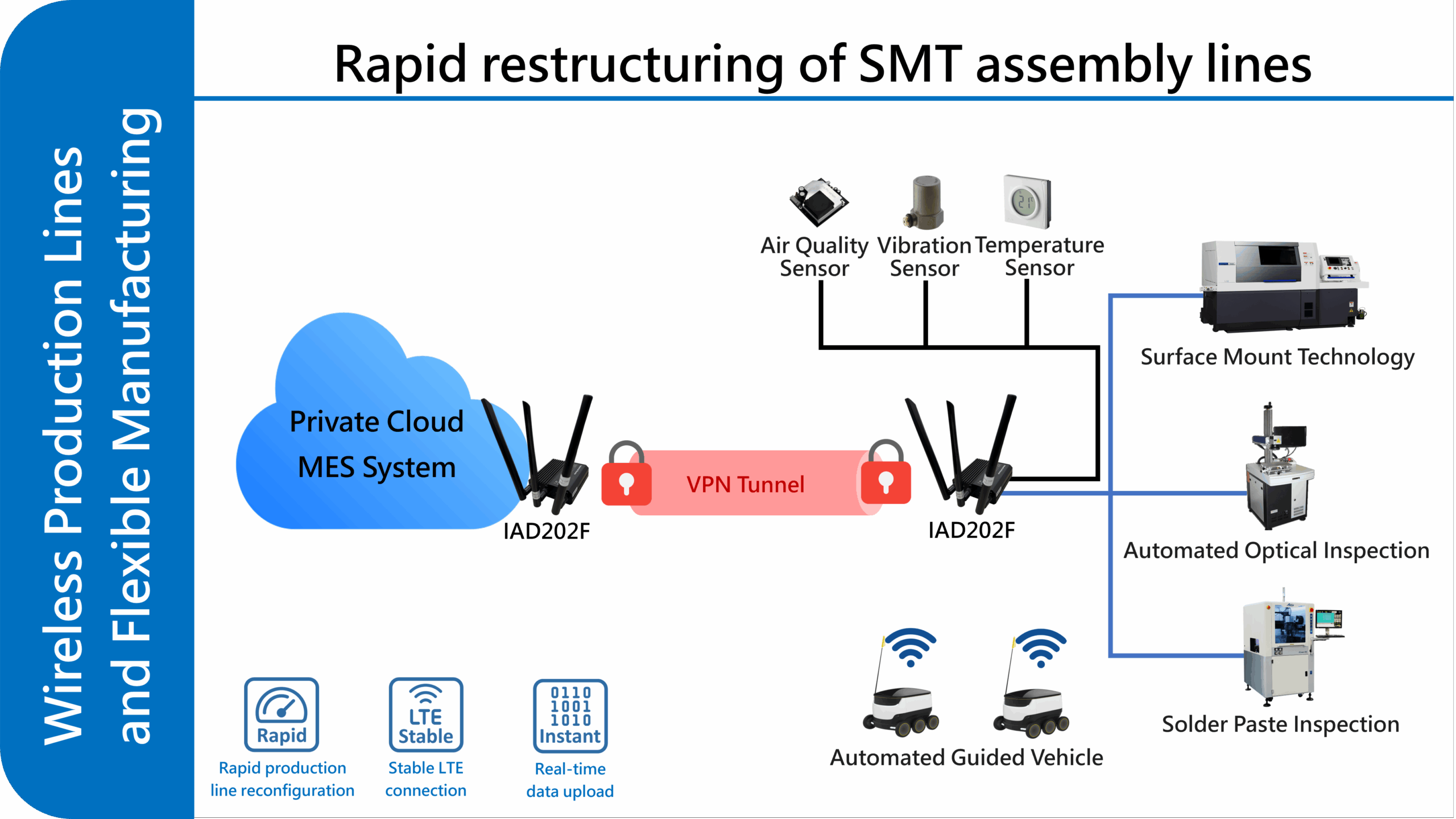
Large manufacturers typically have multiple factories, even distributed across countries. Through the IAD202F's wireless networking capabilities, equipment from various locations can be unified into a central management system. Advantages include eliminating the need for local fixed network infrastructure, rapid deployment of overseas facilities, real-time monitoring of global production capacity, unified cybersecurity policies and VPN architecture. VPN tunnels can securely transmit data from each factory back to headquarters, achieving true global smart manufacturing.
CNC machine tool manufacturers sell equipment globally and need to provide after-sales service and equipment monitoring. However, they often face challenges such as uncontrollable client network environments (firewalls, NAT, etc.), IT security policies restricting external access, high costs associated with sending engineers on business trips for maintenance, and the inability to monitor equipment status in real time.
When enterprises deploy CNC machines across borders, they can integrate or connect to the IAD202F. By inserting a local SIM card, CNC operating data, such as spindle speed, load, and temperature, is transmitted to the headquarters monitoring center via a VPN tunnel. This data is then integrated into the SCADA or MQTT Broker platform. The headquarters monitoring center can then monitor global equipment in real time. In the event of any anomalies, an automatic alarm mechanism is triggered, and engineers can remotely access the equipment via VPN to diagnose and troubleshoot problems.
Benefits of Implementation
● Reduced fault response time from hours to instant response
● Reduced personnel travel and lower maintenance costs
● Establishment of an equipment usage database, providing a basis for product optimization
● Provision of an Equipment-as-a-Service business model